
Microgreens Mastery: 6 Precision Tweaks for 30–50% Heavier Harvests
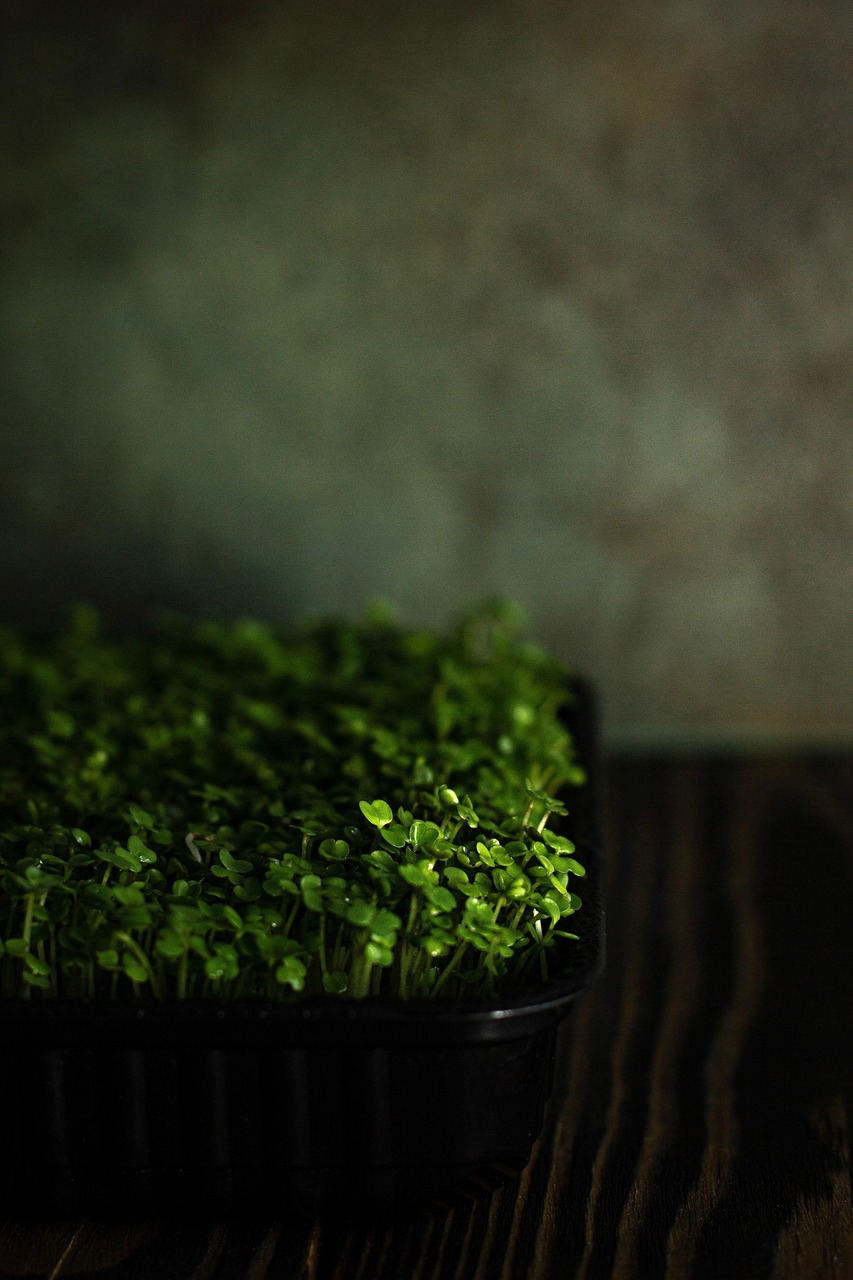
Imagine lifting the lid on day 8 to an emerald carpet that’s noticeably thicker, greener, and heavier than last week—without new gear or guesswork. Here’s how to make that your default result.
Growing microgreens is already one of the fastest ways to turn seed into plate. But when harvests plateau, it’s usually not about effort; it’s about a handful of invisible variables that silently cap yield. Below are six practical, immediately actionable adjustments that directly increase biomass, improve uniformity, and cut waste. They’re grounded in what top growers and recent trials are now standardizing, not rehashing.
1. Treat the First 48 Hours Like a Separate Crop
Germination isn’t “set and forget.” The first 48 hours determine stand count, uniformity, and ultimately, final weight. Two shifts consistently outperform the “cover and pray” approach:
- Weighted blackout: After sowing, lay a light, clean weight (a spare 10×20 tray with ~1–2 lb of sand or weights) on the blacked-out tray. This forces seed-to-substrate contact, reducing uneven stands and “twin” sprouts that compete for resources.
- Variable humidity: Start at 90–95% relative humidity for 24 hours, then drop to 80–85% for the next 24. This prevents the “mushy stem” syndrome on sensitive crops (basil, celery) while still supporting full hydration. A small humidistat inline with your propagation dome pays for itself in one harvest.
Practical tip: If you don’t have a humidistat, crack a corner of the humidity dome incrementally after 24 hours instead of removing it all at once. Observe cotyledon expansion; if they look turgid but not waterlogged, you’ve nailed it.
2. Light Spectrum Is a Yield Lever, Not Just a Color
“Full spectrum” is too vague. Research and commercial grows now converge on a specific ratio for microgreens:
- Blue : Red ≈ 1 : 2.5–3 (roughly 30% blue, 70% red in photosynthetic photon flux). Blue drives compact, sturdy cotyledons; red drives cell expansion and biomass.
- PPFD targets: 200–280 µmol·m⁻²·s⁻¹ for most varieties during the bulk growth phase (days 3–10 for most crops). Higher isn’t automatically better—leaf burn and tip chlorosis rise quickly above ~350 µmol·m⁻²·s⁻¹ for tender varieties.
- Photoperiod: 16–18 hours is a sweet spot. Extending to 20 hours helps slow growers (celery, parsley), but watch for legginess on fast crops (radish, mustard).
Practical tip: If you’re mixing varieties in one tray, orient trays so shorter crops sit at the slightly dimmer edge; or split sow by crop. Uniform light delivery beats forced compromise.
3. Substrate Choice Dictates Root Function, Not Just “Feel”
The substrate isn’t merely a placeholder—it manages water-to-oxygen balance at the root crown, where damping-off starts and where nutrient uptake happens. Three options consistently outperform generic bagged mixes:
- Coco coir + 20–30% fine perlite: Excellent rewet, stable structure, neutral pH. Ideal for most brassicas and herbs.
- Peat + vermiculite (2:1): Holds more initial moisture for uneven environments; watch pH drift over successive batches.
- Hemp mats or biostrate-type felt: Clean, even germination; precise fertigation. Less forgiving on overwatering—dry-down timing matters more.
Practical tip: Always pre-hydrate your substrate to field capacity before sowing. A simple squeeze test—moist but no free water—cuts germination failures by 20–30% in home and small-farm trials.
4. Seeding Density Is More Than “Seeds Per Square”
Overcrowding is the single biggest hidden drag on yield. It drives weak stems, increases humidity pockets, and lengthens dry-down time after harvest.
- Use a calibrated spreader or precision sower for repeatable stands. If hand-sowing, split seed into two passes at 90° angles for better coverage.
- Know your variety’s ideal:
- Broccoli/brassicas: ~10–12g per 10×20 tray
- Sunflower & pea: ~250–300g per 10×20 tray
- Mustard/arugula: ~12–15g per 10×20 tray
Practical tip: Track emergence percentage. If only 70% of seeds germinate, adjust density up slightly rather than cramming more seeds into the same space—seed quality variation is real, compaction costlier.
5. Watering Method Changes Post-Harvest Quality and Speed
How you water affects not just growth, but post-harvest shelf life. Two high-impact techniques:
- Bottom watering after emergence (once cotyledons are fully unfolded) keeps the canopy dry, slashing mold risk on sensitive crops.
- Pulse watering with weight checks: Lift the tray; it should feel heavy at field capacity, lighter as it draws down. When it reaches ~70–75% of that weight, irrigate from below until just moist. This prevents compaction and forces even root exploration.
Practical tip: For stacked or vertical systems, place capillary mats on timers and verify tray weights weekly—weight drift tells you if mats are channeling or wea
6. Disease Prevention Starts with Air, Not Products
Fungicides and sanitizers are last-resort tools. The highest-yielding operations win on environmental control:
- Airflow at the canopy surface: 30–60 linear feet per minute across the canopy prevents boundary-layer saturation where spores germinate.
- Intermittent venting: Even in sealed racks, 2–3 short (3–5 minute) fresh-air exchanges per day drop CO₂ buildup and leaf wetness.
- Sanitation cadence: Clean trays with a dilute peroxide or quat between crops; UV-C on racks monthly if you’re scaling.
Practical tip: A small oscillating fan set on low, placed 2–3 feet from the canopy and angled slightly upward, delivers surprising airflow improvement without desiccating leaves.
Experimentation Is Your Competitive Edge
Microgreens respond rapidly to change—often within a single cycle. Try one variable at a time: for example, compare weighted blackout vs. standard blackout on your next radish tray, or test 250 vs. 300 µmol·m⁻²·s⁻¹ on sunflower. Track weight per tray, stem thickness, and days to harvest. Those small, controlled experiments compound faster than any generic “hack.”
You don’t need new equipment to outpace last season. You just need to pay closer attention to the details that quietly cap yield—and to adjust them, deliberately, one tray at a time.
Your next tray is your test plot. What will you change?




0 Comments