Guides / Growing techniques
Dialing In the Light: How LED Spectrum Ratios Let You Choose Between Yield and Nutrition
Introduction: The Light You Choose Is the Product You Get In our previous article, we explored how Pulsed Electric Fields can supercharge germination
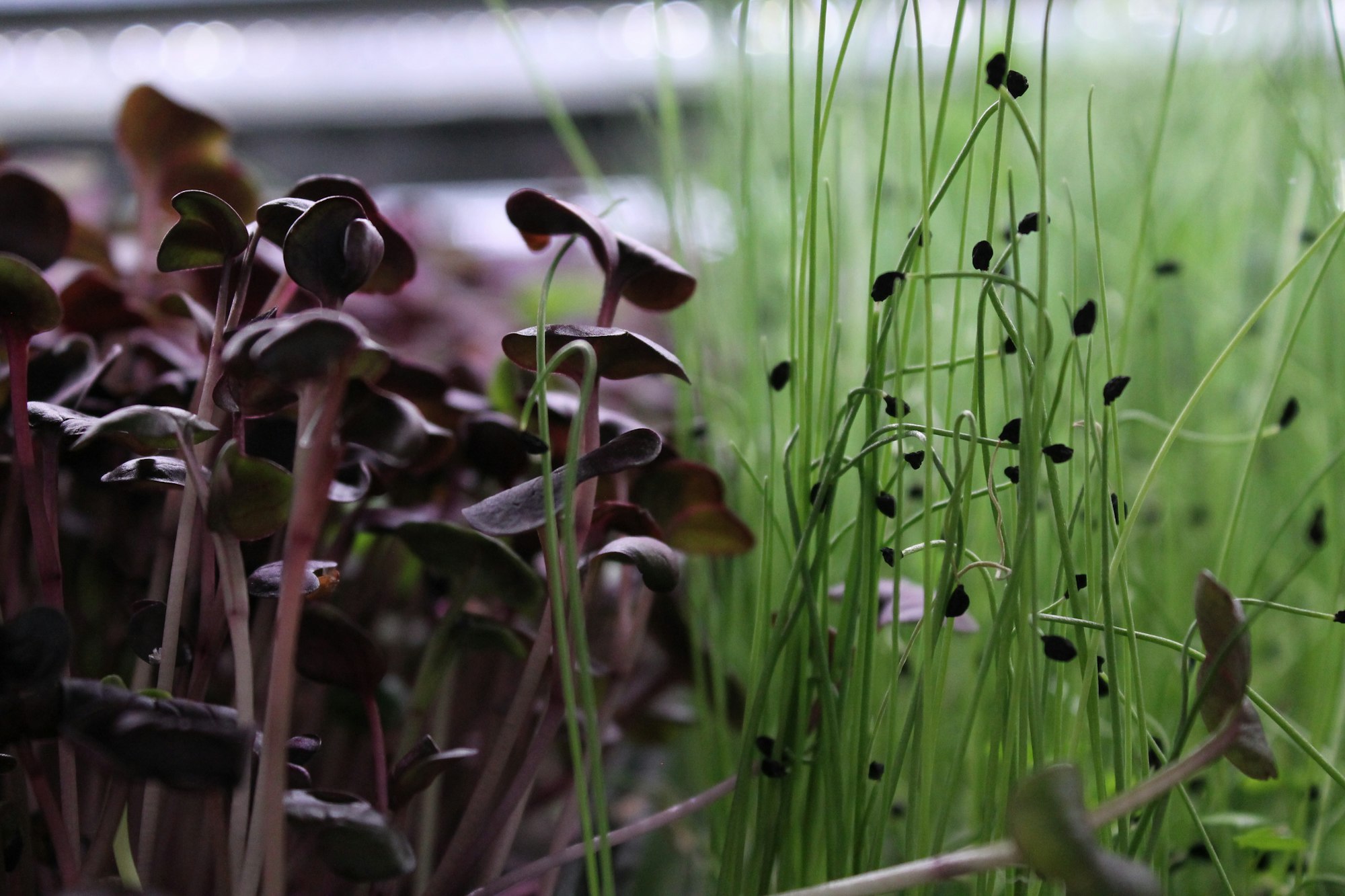
Introduction: The Light You Choose Is the Product You Get
In our previous article, we explored how Pulsed Electric Fields can supercharge germination before a seed even hits the tray. But once those seeds sprout and the first cotyledons unfurl, a different force takes over as the dominant driver of your microgreens’ destiny: light.
Not just the amount of light — the color of light. Or more precisely, the ratio of wavelengths within the spectrum your LEDs emit. And here’s what makes this so powerful for microgreens growers: by adjusting that ratio, you can effectively choose whether your trays prioritize maximum biomass (yield mode) or maximum nutritional density (nutrition mode).
This isn’t theoretical. Two major studies published in early 2026 — one a comprehensive review in Plant Growth Regulation (February 2026) and another an original study in the Journal of the Science of Food and Agriculture (January 2026) — provide the clearest evidence yet that LED spectrum is a precision metabolic steering tool. Let’s break down the science and translate it into actionable recipes for your grow room.
LED Spectrum Science Made Simple
Plants “see” light differently than we do. While humans perceive a continuous spectrum of color, plants have specific photoreceptor proteins that respond to distinct wavelength bands:
- Blue light (400–500 nm): Absorbed primarily by cryptochromes and phototropins. Drives compact, sturdy growth; promotes the synthesis of protective and nutritionally valuable compounds including flavonoids, glucosinolates, and certain vitamins. Tends to reduce stem elongation (shorter, denser plants).
- Red light (600–700 nm): Absorbed primarily by phytochromes. The most photosynthetically efficient wavelength range. Drives biomass accumulation, stem elongation, and leaf expansion. The engine of raw growth.
- Far-red light (700–750 nm): Modulates the phytochrome system, influencing flowering, shade-avoidance responses, and internode elongation. Less relevant for short-cycle microgreens but increasingly studied.
The concept of “precision metabolic steering” means that by adjusting the ratio of blue to red light, you are not just changing how the plant looks — you are changing its internal biochemistry. You’re telling it to invest its energy budget differently.
The Research: What the Data Shows
The February 2026 review in Plant Growth Regulation synthesized findings across multiple species and concluded that:
- Balanced blue-red spectra (50:50) or blue-dominant spectra (70:30 blue:red) produce the highest overall biomass in most microgreens species
- Blue-dominant light also enhances the accumulation of protective secondary metabolites — the compounds that make microgreens “superfoods”
- Pure red or extreme red-dominant spectra produce elongated, leggy growth with lower nutrient density
The January 2026 study in the Journal of the Science of Food and Agriculture went deeper, testing radish microgreens under varying red:blue ratios at 300 μmol/m²/s PPFD (photosynthetic photon flux density):
| Red:Blue Ratio | Biomass (Yield) | Sugar Content | Organic Acid Content | Glucosinolates |
|---|---|---|---|---|
| Highest ratio (5.5) — Red-dominant | Maximum — highest yield | Lower | Lower | Moderate |
| Moderate ratio (~2.0–3.0) — Balanced | Moderate | Moderate | Moderate | Moderate to high |
| Lowest ratio (~0.5) — Blue-dominant | Lower | Maximum — sweetest flavor | Maximum — most complex flavor | Maximum — highest nutritional density |
The pattern is clear and consistent: high red:blue ratios maximize yield , while low red:blue ratios (blue-dominant) maximize nutritional and flavor compounds. This is not a subtle effect — the differences are statistically significant and large enough to matter commercially.
Practical Spectrum Recipes for Growers
Based on the combined research, here are actionable spectrum profiles growers can implement:
| Growing Mode | Red:Blue Ratio | Blue % | Red % | Best For |
|---|---|---|---|---|
| Yield Mode | 5:1 to 6:1 | 15–17% | 83–85% | Maximum biomass; commodity sales; volume-driven operations |
| Balanced Mode | 1:1 to 2:1 | 33–50% | 50–67% | Good yield + good nutrition; general-purpose growing |
| Nutrition Mode | 0.5:1 to 1:1 | 50–67% | 33–50% | Maximum glucosinolates, sugars, organic acids; premium/health-focused sales |
For Home Growers: If you’re using a fixed-spectrum LED panel, check its specifications. Most consumer grow lights lean red-dominant (yield mode). Consider supplementing with a blue-spectrum bar or choosing a full-spectrum panel with adjustable channels for more control. Even small shifts toward blue will increase your microgreens’ nutritional density.
For Commercial Operators: The ability to offer customers a choice — “standard” versus “premium nutrition” microgreens from the same seed stock, differentiated purely by light recipe — is a powerful market position. Growers serving restaurants and health food retailers can command premium pricing for nutrition-mode microgreens with verified higher glucosinolate and antioxidant content.
🔑 Key Takeaway
LED spectrum is a precision tool, not just a light source. High red:blue ratios (5:1+) maximize yield. Low red:blue ratios (blue-dominant) maximize nutritional and flavor compounds. Growers can toggle between modes per tray to match market demand — a capability that represents a genuine competitive advantage.
Leaftix Tie-In: Spectrum-Recipe Profiles in Your Dashboard
This is exactly the kind of intelligence that the Leaftix platform is designed to deliver. Our climate control systems can build and store spectrum-recipe profiles — allowing growers to assign a light recipe to each tray or zone and switch between yield mode and nutrition mode with a few taps.
Here’s how NISA AI enhances the process:
- Species-specific recommendations: NISA draws on published research and community data to suggest the optimal spectrum profile for each microgreens species and target outcome
- Dynamic adjustment: NISA can recommend spectrum shifts during the grow cycle — for example, starting with red-dominant light to drive early biomass accumulation, then shifting to blue-dominant in the final 24–48 hours to boost nutrient density before harvest
- Outcome tracking: Log your spectrum settings alongside yield and quality metrics. Over time, NISA learns which recipes produce the best results in your specific environment
The research is clear: light is not a set-and-forget input. It’s a precision lever. And Leaftix gives you the dashboard to pull it.
📖 Next in the Series
“Beyond Chemicals: Cold Plasma, Ultrasonication, and the Clean Microgreens Revolution” — Publishing June 2, 2026. We’ve covered PEF for germination and LED spectrum for growth. Next, we explore the full landscape of non-thermal seed treatments — from cold plasma to ultrasound to magnetic fields — and assess which ones are ready for your grow room today.
🚀 Ready to Grow Smarter?
Explore how Leaftix can optimize your microgreens operation — from spectrum-recipe profiles to AI-driven grow cycle management. Visit leaftix.com to learn more about our platform and NISA AI.
Ronaldo AndradeWrites practical notes about growing better microgreens.
[01] keep reading